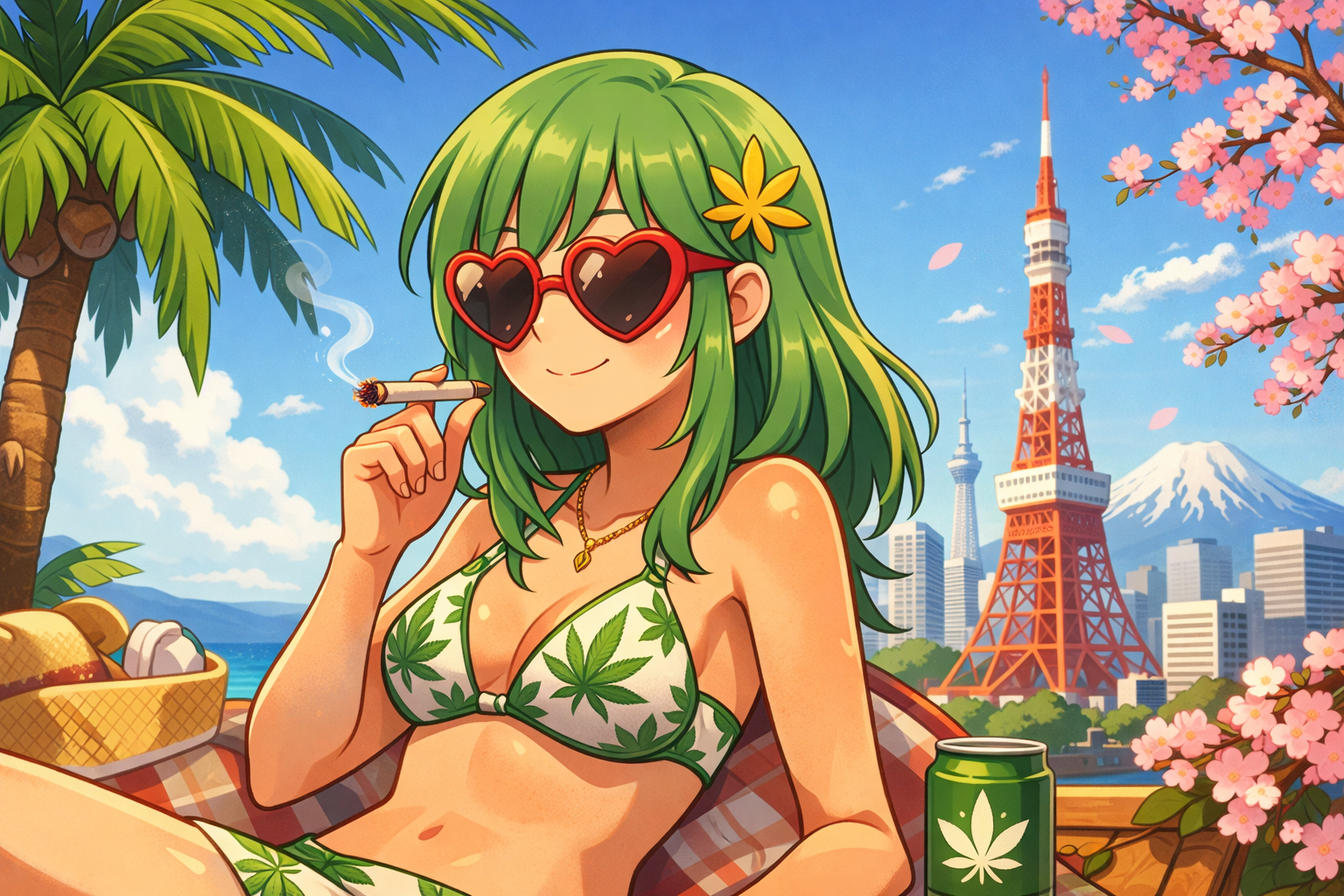
After two glorious weeks in Thailand, legally smoking real cannabis, under palm trees, with zero paranoia, I came back to Japan expecting one of two things. Either I’d feel completely ruined for altnoids… or I’d be desperate to recreate the experience exactly.
What I actually felt was something much calmer: clarity. I feel like I can finally explain what real cannabis is, what altnoids are, and why the difference matters living in Japan. It might not make sense to everyone the same way it does for me, but I’m hoping my real cannabis vs altnoids in Japan comparison does for at least some of you.
So if you’ve ever wondered how real weed compares to Japan-legal alternatives (altnoids), this is my honest take.
(Click here for Japanese / ここをクリックして日本語のレビューをご覧ください)
What People Mean by “Real Cannabis”
When people talk about real cannabis, they usually mean whole-flower weed — that’s the plant as it naturally grows, containing THC, CBD, minor cannabinoids, and terpenes all working together. In places where cannabis is legal and regulated, the experience tends to feel, for lack of a better word… complete.
That’s the entourage effect in action. It’s not one compound screaming, but everything humming together, which explains why you typically feel just right.
In Thailand, that meant a high that felt rounded and emotionally soft. Creative without being frantic. Relaxing without being numbing. Even when it was strong (and some of it really was), it had edges and never felt like it was too much. It also didn’t last long compared to many altnoids. After smoking, it hits almost instantly, builds over the next 10-15 minutes and keeps you feeling right for an hour to an hour and a half — two tops.
So Where Do Altnoids Fit In?
Altnoids exist because Japan bans THC but allows hemp-derived cannabinoids. CBD, H4CBD, H4CBH, HHBD, and others live in that narrow legal lane — either naturally present in trace amounts or derived from legal hemp CBD.
Altnoids are designed, isolated, and blended. They’re often only as good as the vendor who sells them (or more importantly, the “chemist” who makes them). And for folks looking for a legal high in Japan, this is what we’re working with. Thankfully, a number of vendors have emerged to meet the need, though some are better than others.
How the High Actually Feels Different
Here’s the part a lot of us struggle to put into words. Whole-flower cannabis feels like something you enter. Altnoids feel like something that switches on.
If I had to put it another way, real cannabis is butter or milk. It melts in, blends naturally, and behaves the way your body expects. You feel it come on, you ride it, and it fades without much drama. Altnoids are more like margarine or Coffee-Mate. Still functional. Very effective. But processed, engineered, and sometimes more intense than you anticipated.
Real cannabis tends to rise quickly, peak gently, and fade within an hour or two. That makes it forgiving. You feel it fast, you can adjust easily, and if you overshoot a little, you’re not stuck there all night. Altnoids, on the other hand, often come on slower, hit harder than expected, and last much longer.
That’s why people sometimes say altnoids feel “stronger” — because they often are. Not necessarily more pleasant, just more persistent. If you underestimate them, they’ll happily prove you wrong.
Why Some Altnoids Feel Nothing Like Weed
Japan has a few brands that deliberately push the envelope. Some blends are engineered to hit specific receptors hard, amplify body effects, or stretch the duration far beyond what flower would normally do.
As a heavy user? I get the appeal. Sometimes you want to be absolutely flattened. That’s where altnoids can shine, believe it or not. Even lit off my tree in Thailand, I’d lie if I didn’t have a few hankerings for something a little bit more.
But altnoid experiences don’t feel plant-like. They feel designed. The real thing feels, I dunno, organic.
That’s not even a bad thing, it’s just a different intention.
So What Comes Closest to the Plant in Japan?
Once you accept that altnoids aren’t grown but crafted, the question shifts. After asking “which one is the strongest?” I’m finding myself back to basics and asking myself: which ones feel the most natural?
Some Japanese brands are clearly designed to push boundaries — longer duration, heavier body effects, more punch than you’d ever expect from flower alone. As a heavy user, I genuinely appreciate that. Sometimes you want something that goes beyond what weed typically does, and altnoids are uniquely capable of that.
But if what you’re craving is something closer to the plant experience — the taste, the rhythm of the high, the way it rises and falls — terpene-forward products tend to stand out.
This is where Kush JP really shines for me. Rather than chasing extremes, their approach feels grounded in familiarity: realistic flavor, smoother onset, and effects that don’t feel like they’re trying to overwhelm you. Nothing in Japan is identical to whole-flower cannabis, but sensorially and emotionally, Kush JP gets closer than most.
I’ve also been hearing genuinely great things about Umeboshi, especially when it comes to realistic taste and terpene profiles. I haven’t had the chance to try them yet, but they’re firmly on my radar, and I’m really looking forward to seeing where brands like that take things next.
At the End of the Day… High Is High 😅
Here’s the part worth zooming back out for.
You’re still getting high.
Just like cannabis strains vary wildly, altnoids vary too — especially in how they’re blended. Two products with the same cannabinoids listed on paper can feel completely different depending on formulation, terpenes, skill, and intent.
It’s also worth saying plainly: altnoids are often stronger and longer-lasting than real cannabis. Whole-flower weed is quick and forgiving with a fast onset, clear peak, and usually gone within an hour or two. Altnoids can creep up on you and stick around for much longer, which is great when you want it… and humbling when you don’t.
None of this makes altnoids lesser. If anything, it makes me grateful we have them at all. Living in Japan means working within the reality of the law, and the fact that we have access to thoughtfully made, effective, and increasingly sophisticated alternatives is something I don’t take for granted.
Do I hope Japan’s relationship with cannabis evolves one day? Of course. Do I expect it anytime soon?
…let’s be real 😅
But until then, I’m genuinely thankful for the options we do have and excited to see how much better they keep getting.
High is high.
The rest is nuance. And as always, stay lifted — legally. 🍃

Leave a Reply