
Japan’s legal cannabinoid market may be facing a major shift. The one we’ve all been dreading. I know I’ve been posting about this a lot, but I want to keep you all up to date.
Japan’s legal cannabinoid market could be heading for another major shift. Newly circulated documents from the Ministry of Health, Labour and Welfare suggest regulators are preparing to designate CBN (cannabinol) as a “designated drug” (shitei yakubutsu, 指定薬物), with a proposed enforcement date of June 1. If implemented, the move would effectively remove most recreational CBN products from the Japanese market.
Where the June 1 Date Appears
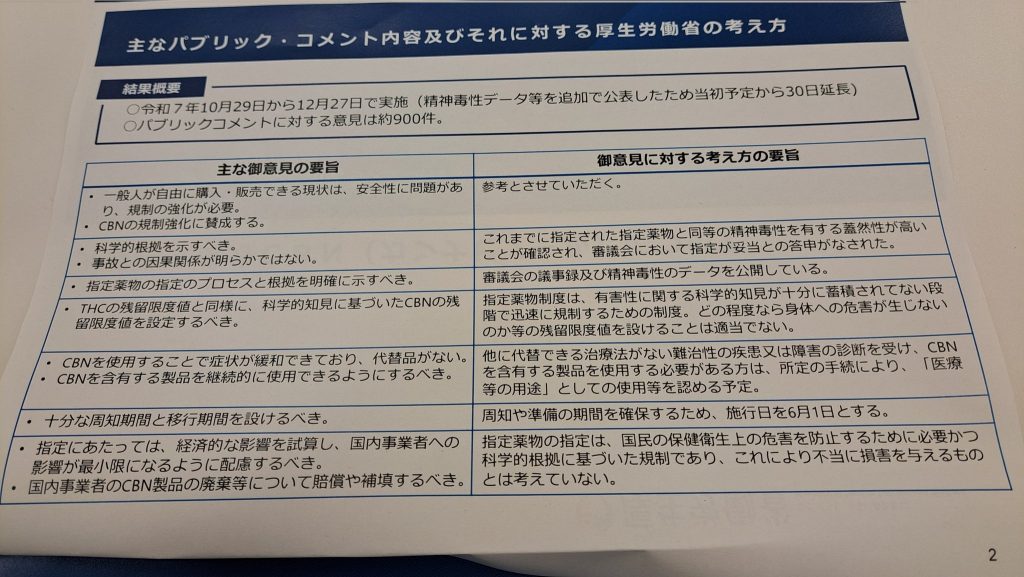
In the document released during the policy discussion, the ministry states:
“To ensure time for public notification and preparation, the enforcement date will be set as June 1.”
This suggests regulators plan to give businesses and consumers a short transition period before the rule takes effect. The consultation process reportedly collected around 900 public comments between October and December 2025.
What “Designated Drug” Means in Japan
If CBN is formally designated as a designated drug (shitei yakubutsu, 指定薬物), it would join a long list of substances restricted under Japan’s Pharmaceutical Affairs framework.
In practical terms, this typically means:
- Retail sale becomes illegal
- Possession and use become illegal
- Import and manufacturing are prohibited
- Distribution is restricted to highly controlled channels
- Most recreational products disappear from the market
Japan has used this classification repeatedly to control emerging cannabinoids and synthetic compounds.
Why Japan Uses the “Designated Drug” System
Japan’s designated drug system is designed to respond quickly to emerging substances that fall outside existing drug laws. Instead of waiting years to amend major legislation, regulators can add new compounds to a controlled list under the Pharmaceutical and Medical Device Act. This approach has been used repeatedly over the past decade to restrict synthetic cannabinoids and other newly emerging substances. Once a compound is designated, businesses must immediately stop manufacturing, importing, or selling it in Japan.
For consumers, this usually means products disappear from the market almost overnight — even though the designation system itself primarily targets the supply chain rather than individual users.
Government Concerns About CBN
In its response summary, the ministry explains that the designation system is used when a substance may pose psychotropic or health risks, even if full scientific data is still developing. Officials also rejected suggestions that CBN should be treated similarly to THC contamination limits.
Instead, regulators argued that insufficient scientific data exists to establish safe thresholds, making full designation the preferred approach.
Possible Medical Exception
One notable detail in the document suggests a narrow exception could exist. The ministry indicated that individuals with serious illnesses lacking alternative treatments may be able to access CBN products under specific medical-use procedures. However, Japan’s regulatory systems for such access are typically extremely strict, and it remains unclear how practical this pathway would be.
Impact on Japan’s Cannabinoid Market
CBN has become one of the most common cannabinoids sold legally in Japan, particularly in:
- Sleep-focused vape cartridges
- Gummies and edible blends
- CBD + CBN relaxation formulas
If the proposed designation moves forward, these products could disappear from shelves almost overnight. For companies operating in Japan’s cannabinoid industry, the June 1 timeline would represent a very short window to clear inventory or pivot to other cannabinoids. Still, some vendors have already begun offering sales on CBN products and developing CBN-free products with similar effects.
CBN Recommendations
Before the new law comes into effect, here’s what I like:
What Happens Next
At the moment, this info reflects the government’s response to public consultation, not the final ordinance itself. However, once Japan’s health ministry reaches this stage of the process, policy changes often move quickly toward formal designation. If confirmed, June 1 could become a significant turning point for Japan’s cannabinoid market. For now, consumers and businesses alike will be watching closely.
And in the meantime, get what you can while you can and stay legally lifted 🍃
This article will be updated if Japan’s Ministry of Health releases additional details about the proposed CBN designation.
Source: @mutaishunsuke
Quick note: This post may contain affiliate links. If you purchase them, it helps support Mary Jane in Japan and keeps this site running. Thank you! As always, opinions here are my own.


Leave a Reply