

First published: July 7, 2026 / Last updated: July 28, 2026
Japan’s cannabinoid scene has a new three-letter plot twist: CBX. The CBX cannabinoid in Japan is already appearing through raw-material suppliers and brand posts, with claims of a fast-arriving, strong but clear, sativa-leaning experience.
And all before we’ve even had time to catch our breath from THAH! But once again, this new mystery ‘noid has naturally raised a very important question: what exactly is CBX—and is it about to become the next ingredient everyone is talking about?
The short answer is: we do not know enough yet to call CBX a fully explained cannabinoid. But we do know enough to say it is already moving beyond vague rumours and into the Japanese market.
Latest Updates
🚨Update: KushJP Full CBX Guide (July 28, 2026)
I’m sorry I’ve been so busy and haven’t been able to update. But I have good news and more good news: First, I’ve gotten my hands on a few CBX products and have been reviewing them one after another! And more good news is that KushJP has written a FULL explainer on what we have here in Japan.
They’ve also released their own CBX product called BOLT which I have tried, loved and reviewed.
🚨 Update (July 13, 2026): CBX has been on sale over the past few days from vendors like Regal Dojo, Knockout, G/M Shop, Canna Canna and more. I’ve got some coming from Regal Dojo as I type, and I can’t wait to try it. Stay tuned, because you know I’m going to be reviewing this.
🚨 Update (July 7, 2026): A Japan-Specific Explanation of CBX Has Emerged (see further below)
What Japanese sellers are claiming about CBX
REGAL Dojo recently posted that CRDP production ended last month, but said it plans to release CBX soon. The company described CBX as being made in the same lab as CRDP and suggested it has a satisfying “catch,” dry-mouth presence and a good “抜け” or finish—the Japanese term often used to describe how cleanly an effect fades away.
That does not prove CBX is a CRDP replacement. But it does suggest that suppliers may be looking for something that can fill at least part of the gap left by CRDP: a material with a noticeable effect, a distinct character and enough appeal for brands to build products around it.
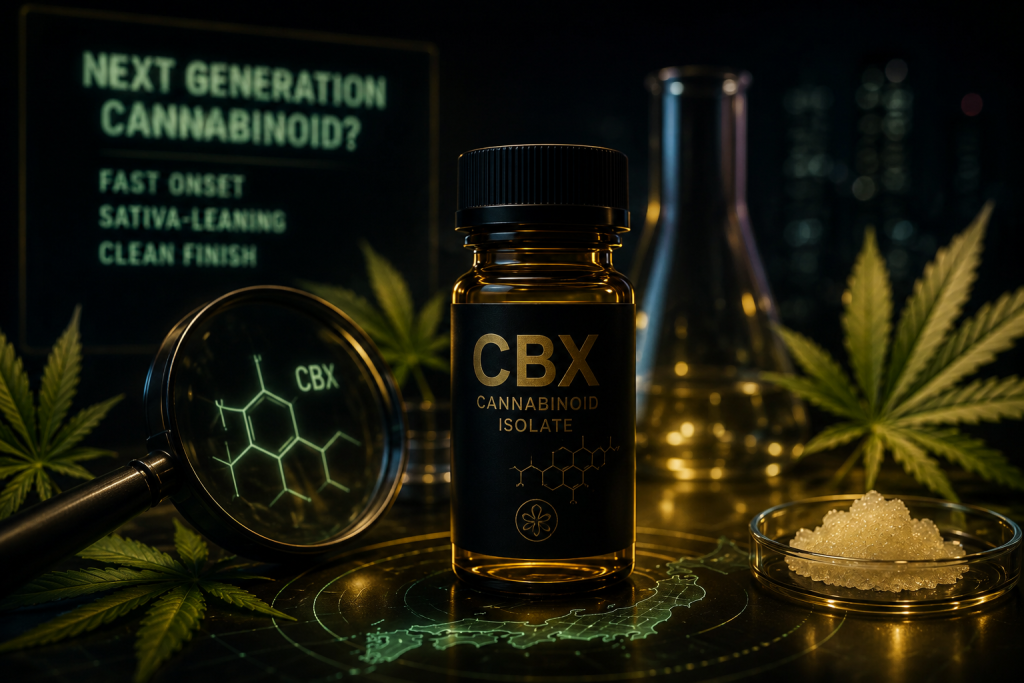
Meanwhile, Canna Canna is already advertising CBX as a high-purity cannabinoid isolate, available from one gram. Its promotional material claims fast onset, a strong perceived effect, a sativa-leaning experience, and a clear, quick finish. In other words: CBX is being marketed less as a sleepy “cancel my plans and merge with the sofa” cannabinoid, and more as something alert, punchy and relatively clean on the way out.
Trip Japan is also carrying CBX raw material, while brands including KushJP and Tensuke appear to be experimenting with it. On X, early chatter has similarly described it as sativa-like—but that is still anecdotal, not established science.
The CBX Question Mark
Here is where it gets interesting.
CBX is not necessarily a brand-new label in Japan. I have seen products carrying CBX-related wording as far back as 2024, and Delta Farms previously sold something called CBXE. Are CBX and CBXE related? Is CBX a revived material, a new formulation, a shorthand, or simply another example of cannabinoid naming becoming a little too alphabet-soup-adjacent for everyone’s own good?
Right now, there is no public answer I would feel comfortable treating as fact.
None of the material I have seen so far clearly identifies what CBX is. That means we should separate two things: what sellers are claiming CBX feels like, and what CBX chemically is. Those are not the same question.
Update: Japan-Specific Details on CBX
Japanese retailer Lil Ganja has now shared more information about the CBX being sold in Japan. They describe CBX as a hemp-derived converted cannabinoid distillate containing C4-chain compounds—meaning its molecules have a four-carbon side chain that may affect how they interact with the body.
Lil Ganja also says CBX is made using a similar conversion concept to CRDB and is believed to act as a partial agonist at the CB1 receptor. In simple terms, it is claimed to activate a key cannabinoid receptor, but not necessarily to the same maximum extent as a full agonist. That may fit with the fast-onset, noticeable-but-clear experience brands are marketing.
Important caveat: these are supplier-provided claims, and public research on CBX remains limited. I have not yet seen Japan-specific independent documentation confirming the exact compounds of CBX.
This also means the 2025 European study of a product labelled “CBx” may not describe the same material: that paper identified a C3-chain THC analogue, while Lil Ganja describes Japan’s CBX as containing C4-chain compounds. Same letters, potentially very different chemistry.
Update: A Possible Chemical Identity for “CBX” (but looking unlikely)
After this article was published, a Redditer shared a 2025 analytical study that examined commercially sold European products labelled “CBx.” The researchers found that the main ingredient was not a naturally occurring cannabis compound. Instead, it was a newly identified semisynthetic cannabinoid: a chemically modified relative of Δ8-THC.
In plain English: the “CBx” tested in that study was a lab-made THC-like compound, not a simple CBD-style isolate. The sample also contained a closely related second compound, meaning the product was not one perfectly single, uniform molecule.
Could that be the same CBX now appearing in Japan? Possibly—but it is not confirmed. “CBX” appears to be a commercial name rather than one standardized chemical identity, so a Japanese supplier would need to publish a chemical name, structure, or product-specific lab analysis before anyone can responsibly say they are the same thing.
The safety part matters too. The researchers noted that these newly appearing semisynthetic cannabinoids often have little or no established toxicology data—meaning we do not yet have reliable information on safe doses, short-term risks, long-term effects, interactions, or how they behave across different people. They also warned that products sold under these names can be complex mixtures, not always the single compound implied by the label.
That does not automatically mean CBX is dangerous. It does mean the marketing claims around fast onset, strong effects, and a “clear” finish should not be mistaken for safety evidence. Until Japan-specific technical documentation appears, CBX is best treated as an interesting but still under-explained new arrival.
Source: Dadiotis et al., “Identification of Three Novel Tetrahydrocannabinol Analogs in the European Market,” Drug Testing and Analysis (2025).
Final Thoughts
For now, CBX looks like one to watch. The marketing language is already unusually consistent: fast onset, noticeable impact, sativa-leaning clarity and a quick, clean finish. If brands begin releasing finished CBX vapes, edibles or blends, we will learn much more quickly whether that identity holds up outside a raw-material listing.
Until then, CBX is Japan’s newest cannabinoid mystery—wearing a very expensive-looking gold label and refusing to show us its ID. And I’ll do my best to keep this space updated with what I know, as I know it. 🍃
Quick note: This article may contain affiliate links, which means I may earn a small commission if you purchase through them, at no extra cost to you.




Leave a Reply